Cap meaning, in today’s slang, is simple: it means a lie or an exaggeration. If a friend tells you something hard to believe, you might just reply with one word — “cap.” You’ve probably seen it in a text, a TikTok comment, or a caption that says “no cap.” Both phrases show up constantly online, and if you’re confused, you’re not alone.
This guide breaks down where the word comes from and how people actually use it. You’ll see how cap and no cap work across social media, chats, and even dating apps. It also covers the handful of totally different meanings “cap” carries outside of slang. By the end, you’ll know exactly how to spot it and respond to it in any conversation.
Meaning & Definition of Cap
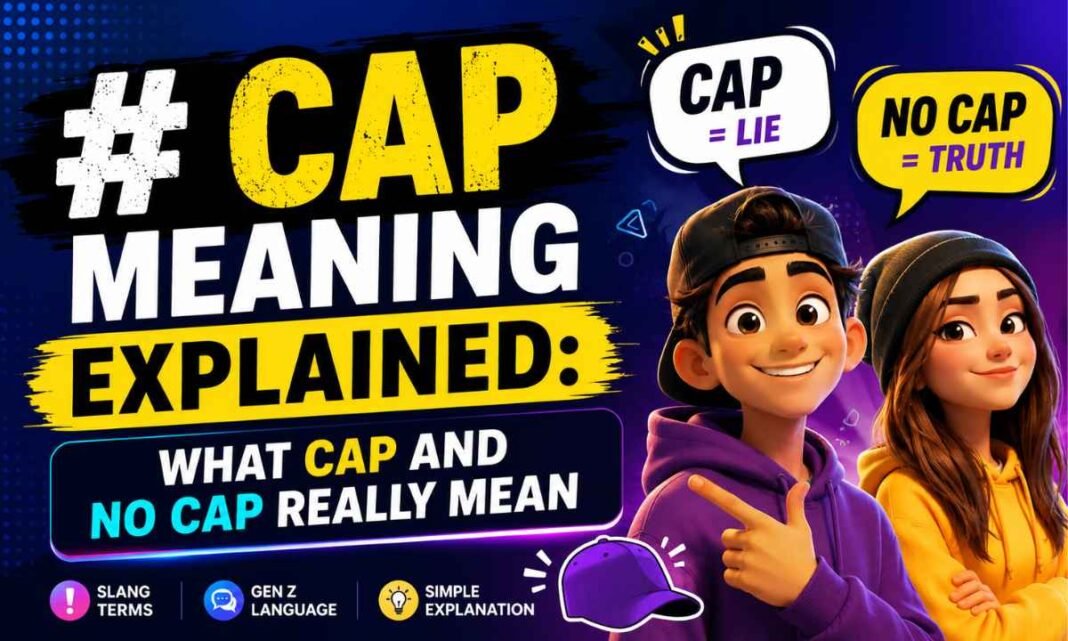
In slang, cap means a lie, a false claim, or an exaggeration. “No cap” is the opposite — it means someone is telling the truth. That’s the short version, and it’s the definition you’ll see used the most across social media today.
Here’s the quick breakdown:
- Cap = lie, fake, or exaggerated
- No cap = truth, honest, for real
Example: “She said she ran a marathon in two hours, that’s cap.” Or the flip side: “I finished the whole assignment last night, no cap.”
Outside of slang, “cap” still has its older, literal meanings. It can mean a hat, a bottle lid, or a limit, like a salary cap in sports. Context always tells you which meaning is in play. When you see it in a casual chat or comment section, it’s almost always the slang version.
Grammatically, cap works as both a noun and a verb. “That’s cap” uses it as a noun. “Stop capping” uses the verb form, and “he capped again” is the past tense. Once you know these forms, the cap meaning in any sentence becomes easy to spot.
Background & Origin of Cap
The slang sense of cap comes from African American Vernacular English (AAVE), and it’s older than most people assume. “Capping” was used to describe boasting or bragging long before it became shorthand for lying, and that older sense goes back decades in Black American speech and hip-hop culture.
By the 2010s, rappers and artists helped push “cap” and “no cap” into mainstream music, and the phrase started appearing in song lyrics and interviews. From there, it spread fast through Twitter, YouTube comments, and eventually TikTok, where it became one of the platform’s most recognized slang terms.
Cap slang origin stories often skip this detail: the word didn’t start as internet slang. It started as spoken street vocabulary, and social media simply gave it a bigger stage. By 2019 and 2020, “no cap” had gone fully viral, and it hasn’t really faded since.
This history matters because it explains why the cap meaning slang we use today feels so natural in speech. It wasn’t invented for texting. It was adapted from how people already talked, which is part of why it spread so easily once social media picked it up.
Usage in Different Contexts
How you use “cap” depends heavily on where you are and who you’re talking to. It shifts naturally between casual chats, memes, and even the rare formal setting.
Social Media
On platforms like TikTok and X, cap shows up in captions, comments, and quote posts. “This edit took me five minutes, no cap” is a typical example you’ll see under a video.
Chat Conversations
In one-on-one texts, cap works as a quick way to question or confirm something. “You got the job? No cap?” is a common reply when news feels almost too good to be true.
Entertainment & Memes
Meme culture leans on cap heavily. It’s used to poke fun at exaggerated claims, dramatic reactions, or obviously staged videos, often paired with the 🧢 emoji for extra emphasis.
Professional Tone (rare)
Slang cap almost never appears in professional writing. But the older, literal meaning does. You’ll hear “cap meaning in business” come up in phrases like “budget cap” or “spending cap,” which describe a set limit rather than anything to do with honesty.
Meanings Across Platforms
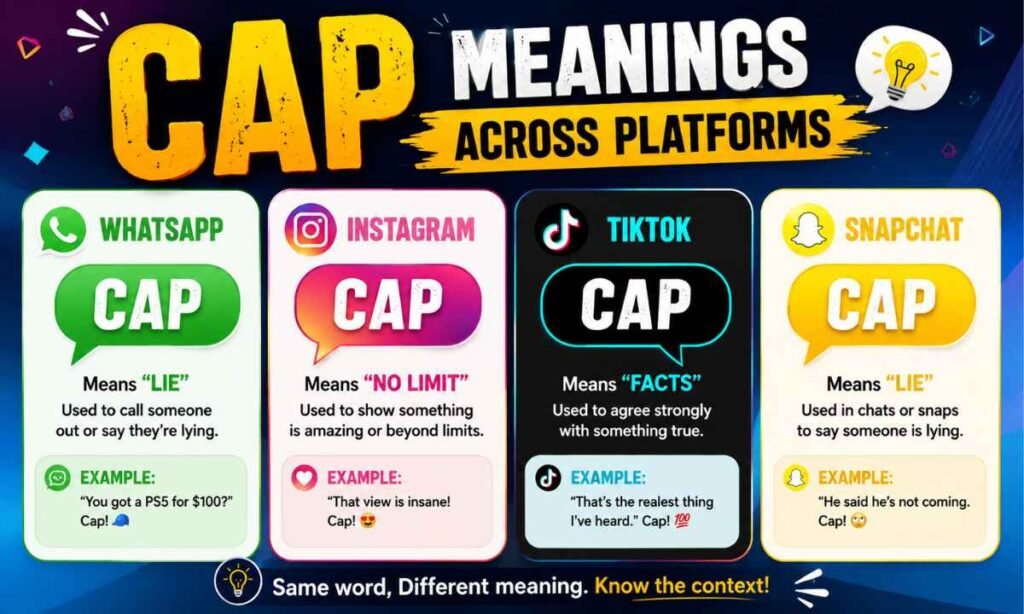
Cap slang doesn’t look exactly the same everywhere. Each platform has its own rhythm for using it.
WhatsApp chats tend to use cap in short, blunt replies: “You studied all night? Cap 😆” It fits naturally into fast back-and-forth messaging between friends.
On Instagram, cap shows up mostly in captions and comment threads. “Living my best life, no cap ✨” is the kind of caption you’ll spot regularly.
TikTok
TikTok is where cap gets the most daily use. Comment sections are full of it, especially under videos making bold or unbelievable claims. It’s become part of the platform’s core vocabulary.
Snapchat
Snapchat usage skews more personal and reactive, often as a one-line response to a friend’s story or snap: “That’s cap 😂 stop lying.”
Other Fields Meanings
Slang isn’t the only place “cap” shows up. It carries different weight depending on the industry.
| Field | Cap Meaning |
| Finance / Business | A limit or ceiling, like a price cap or spending cap |
| Football / Sports | Cap meaning in football refers to a player’s appearance for their national team, or a salary cap for a club |
| Medical | Short for capsule, a common medicine form |
| Aviation | Civil Air Patrol, abbreviated CAP |
| Engineering | A protective cover or top piece |
So cap meaning in English genuinely depends on the sentence. A financial analyst, a football fan, and a teenager texting a friend are all using the same word for very different things. None of these definitions are wrong. They just belong to different worlds, and only the slang version means cap meaning lie.
Common Misconceptions & Mistakes
A lot of confusion around this word comes from mixing up its meanings or missing the tone. Here are the most common mix-ups:
- Thinking “cap” always refers to a hat
- Assuming “no cap” means “no hat on”
- Using slang cap in a formal email or report
- Confusing it with unrelated words like “capital” or “capable”
Getting it right just takes context. If you’re reading a casual message, it’s almost always the slang meaning.
Similar Terms & Alternatives
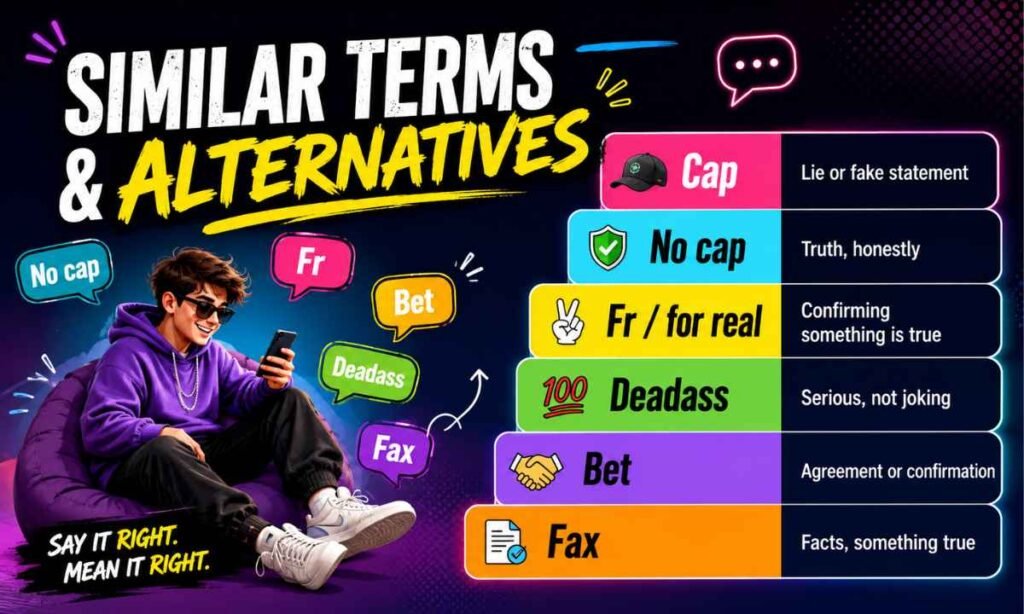
Cap belongs to a small family of honesty-related slang terms that often show up together in the same conversation.
| Term | Meaning |
| Cap | Lie or fake statement |
| No cap | Truth, honestly |
| Fr / for real | Confirming something is true |
| Deadass | Serious, not joking |
| Bet | Agreement or confirmation |
| Fax | Facts, something true |
These words get mixed and matched constantly. You might see “no cap, deadass” used together for extra emphasis.
How to Respond to “Cap”
If someone calls “cap” on you, a few natural replies keep the conversation light and casual:
- “No cap, I’m serious.”
- “You think it’s cap? I’ve got proof.”
- “Okay, fair, that did sound like cap.”
- “100%, no cap, trust me.”
Tone matters here more than the words themselves. Most of the time, calling something “cap” is playful, not a real accusation of lying.
Differences From Similar Words
Cap and lie aren’t quite the same register. Lie is formal and can carry real weight, while cap is casual and often used jokingly, even between close friends. Fake is broader and less tied to speech specifically, while cap almost always describes something someone said. And “no cap” carries a very different tone from “honestly” — it’s more current, more casual, and tied closely to internet culture rather than everyday formal speech.
Relevance in Online Conversations & Dating Apps
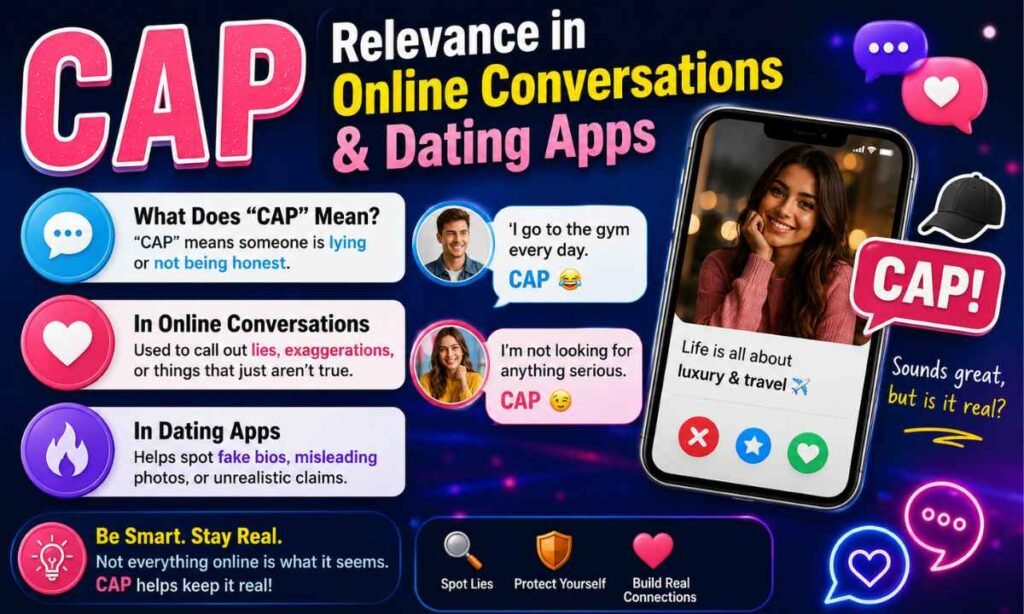
Cap slang shows up often in dating app messages, where it adds a light, low-pressure way to flirt or test honesty. “No cap, you’ve got the best smile I’ve seen on here” reads as playful rather than overly serious. It also works the other way: “That’s cap, nobody’s profile bio is that funny” pokes fun without sounding harsh. In both cases, it helps conversations feel more natural and less scripted.
Popularity & Trends Over Time
Cap has had a fairly steady climb rather than a short-lived spike. Its trajectory looks something like this:
- 2015–2017: Mostly contained to hip-hop and AAVE speech communities
- 2018–2019: Spread through Twitter and early meme culture
- 2020: Exploded on TikTok, becoming a mainstream Gen Z staple
- 2021–2026: Still widely used, with steady search interest year over year
Cap meaning Gen Z searches tend to spike whenever a new TikTok trend or viral audio clip uses the phrase, but overall interest has stayed fairly consistent rather than fading like some slang does.
Frequently Asked Questions
What does cap mean in slang?
“Cap” means a lie, exaggeration, or something false. It’s used to call out claims that sound made up or too good to be true.
What does cap mean on social?
Across TikTok, Instagram, and X, “cap” flags exaggerated or unbelievable claims in captions, comments, and replies.
Why do kids say no cap?
They say “no cap” to stress they’re being fully honest, similar to adding “I swear” or “for real” to a sentence.
What does “cap it” mean in slang?
It’s used the same way as “cap” — pointing out that a statement is false, fake, or overstated.
What is the opposite of cap?
“No cap” is the opposite of cap. It means someone is telling the truth, with no lie or exaggeration involved.
Conclusion
At its core, cap meaning comes down to one simple idea: calling out a lie or exaggeration, with “no cap” standing in for honesty. It grew out of AAVE and hip-hop culture, then spread through platforms like TikTok, Instagram, and Snapchat until it became everyday vocabulary. Along the way, it picked up a whole family of related terms like “fr,” “deadass,” and “bet.”
Beyond slang, “cap” carries entirely separate meanings in finance, football, and business, so context always decides which version applies. Whether you’re texting a friend, scrolling social media, or messaging on a dating app, knowing the cap meaning helps you follow along and respond naturally. This slang isn’t fading anytime soon, and now you’re fully equipped to use it right.