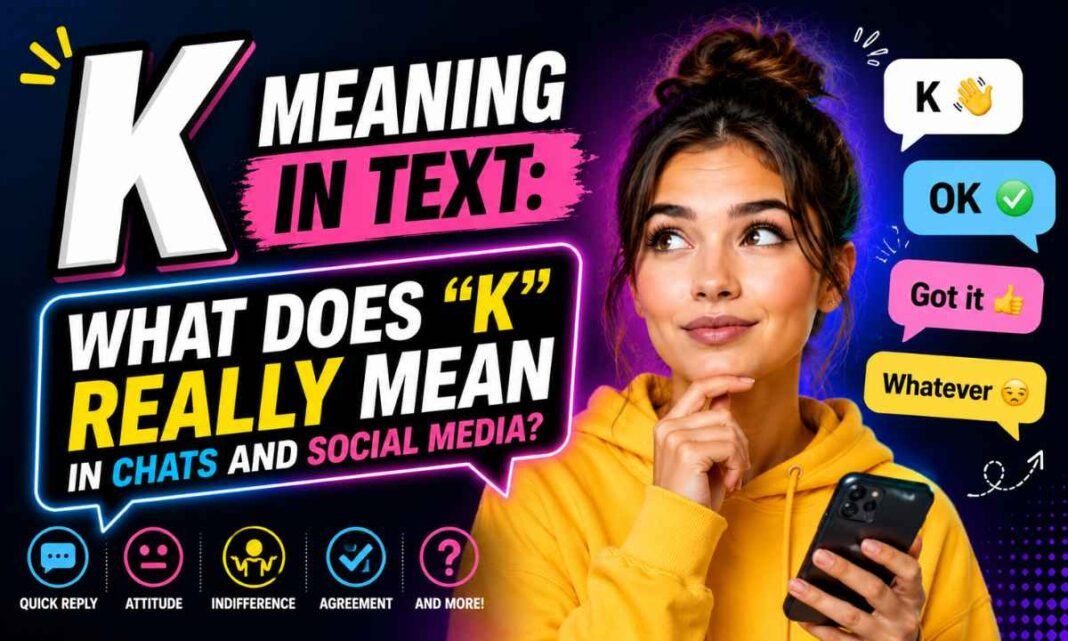
K meaning in text is simple on the surface. It stands for “okay,” a fast way to confirm that you read and understood a message. But if you have ever sent someone a real question and gotten back a single “K” with nothing else attached, you know this tiny letter can carry a lot more weight than a plain okay. Millions of people type it every day across group chats, DMs, dating apps, and work messages, and most of the time it is completely harmless.
Still, context changes everything. A bare K after a casual plan feels nothing like a bare K after an apology, even though the letter never changes. That gap between what K technically means and how it actually feels is why this phrase gets searched so often, and this guide breaks it down clearly, covering platforms like WhatsApp, Instagram, and Snapchat along with how to respond.
Meaning & Definition of K in Text
At its core, the meaning of K in text is a shortened form of “okay,” one letter doing the job of a full word.
Primary Meaning of “K”
In most everyday texting, K simply means yes, understood, or confirmed. Someone sends a plan, a time, or a piece of information, and you reply with K to show you got it.
- “Dinner’s at 7.” → “K”
- “I’ll text you when I land.” → “K”
In these situations, K is doing exactly what OK or Okay would do, just faster.
Secondary Meanings of “K”
Tone changes everything. The same letter can also read as annoyed, distant, or cold, especially after a longer message or an apology.
- “I’m really sorry about earlier.” → “K”
That reply feels different from a quick K after a casual plan, even though the letter itself never changed.
Why Tone Matters
Texting strips out the things that normally tell us how someone feels, like facial expressions and voice. Readers fill in the emotional gaps themselves, often assuming the worst.
A single K can feel neutral or sharp depending on punctuation and pacing. “kk” tends to read as warm, while “K.” with a period often reads as final or annoyed. This gap between what K technically means and what it feels like is why so many people search this exact phrase.
Background & Origin of K
K did not start with smartphones. It has roots that go back nearly two centuries.
Where Did “K” Come From?
Okay became popular in American newspapers in the 1800s as a playful misspelling of “all correct,” written as “oll korrect.” It got a further boost from Martin Van Buren’s 1840 presidential campaign, since his nickname was “Old Kinderhook,” and OK clubs formed to support him.
Connection Between “OK” and “K”
Once mobile texting arrived in the late 1990s, character limits and slow keypads made every letter count, so okay became OK, and OK eventually became just K.
Internet Culture Influence
As chatting moved online through forums and instant messaging, K stuck around even after character limits stopped mattering, shifting from saving time into sending a tone.
Usage in Different Contexts
The k meaning in text shifts depending on who sent it and why, especially across different types of relationships.
Casual Chats
Among friends, the k meaning in chat is usually just a quick nod. Nobody reads much into it, since the relationship already has trust built in.
Romantic Conversations
The k meaning in love and dating conversations tends to carry more weight. A one letter reply after a meaningful message can feel like disinterest, even when that was never the intention.
Workplace Communication
At work, K can come across as too blunt. Most professionals lean toward “Got it” or “Sounds good,” which sound more complete without much extra typing.
Gaming Communities
In gaming chats, speed matters more than warmth. A K during a match usually just means “understood, moving on,” with no emotional weight attached.
Meanings Across Platforms
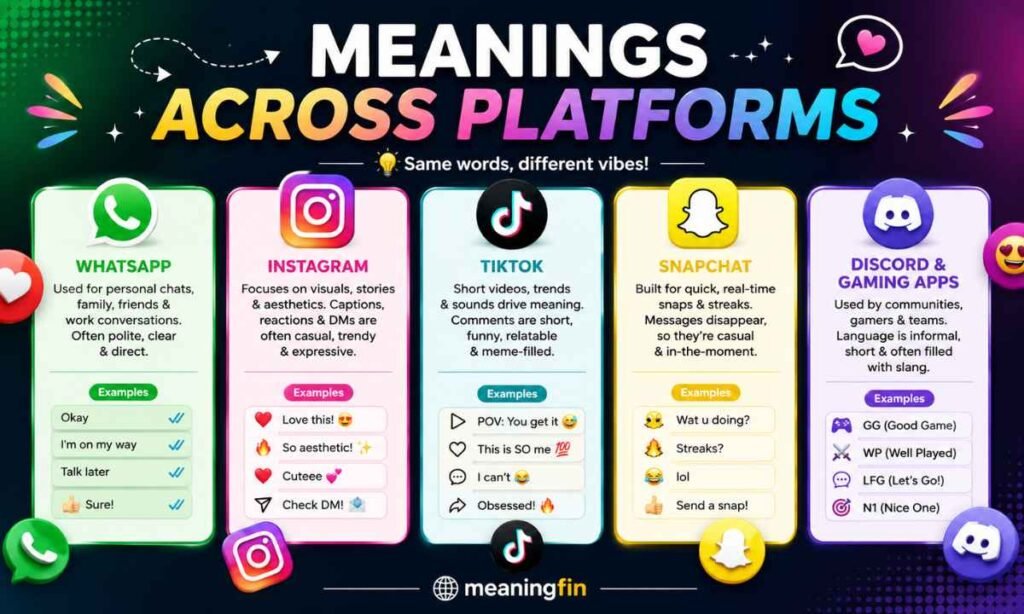
The letter itself does not change from app to app, but how much people scrutinize the k meaning in text does shift by platform.
| Platform | Typical Read on K |
| Practical, though closer chats may read it as short | |
| Quick, low stakes acknowledgment | |
| TikTok | Casual, often used jokingly in comments |
| Snapchat | Fast confirmation that a snap or message was seen |
| Discord & Gaming Apps | Purely functional, tied to speed rather than emotion |
The k meaning in WhatsApp usually stays literal, since most threads involve people who know each other well.
On Instagram, K often shows up in DMs when someone wants to keep a chat moving quickly.
TikTok
TikTok comments use K casually, without the scrutiny it gets in a private chat.
Snapchat
Because Snapchat conversations move fast and disappear, a K there usually just confirms the message was seen.
Discord & Gaming Apps
Inside gaming communities, K is purely functional, confirming a strategy or call out mid match.
Examples in Real Conversations or Memes
Seeing K in context makes the tone easier to read.
Friendly Examples
- “Movie starts at 8.” → “K 😊”
- “Don’t forget the snacks.” → “kk”
Annoyed Examples
- “I can’t make it today.” → “K.”
- “You never texted me back.” → “k”
Meme Culture
Online, K has become a running joke. People often say a paragraph feels safer than a single letter K, and screenshots of blunt K replies get shared constantly because so many relate to that feeling.
Cultural or Regional Interpretations
Not everyone reads K the same way, and geography plays a role here.
Western Internet Culture
In English speaking countries, K often sounds more clipped than “okay” or “ok,” part of why it gets analyzed so often online.
South Asian Usage
In many South Asian texting circles, including Pakistan and India, K is used constantly and casually, without the negative connotation it carries elsewhere.
Younger vs Older Users
Younger texters tend to read emotional meaning into K, while older users typically treat it as harmless shorthand.
Other Fields: Technical Meanings of K
Texting is not the only place K shows up. Understanding K meaning in numbers and other fields helps avoid confusion outside of chat.
| Field | What K Means |
| Physics | Kelvin, the unit of temperature |
| Mathematics | A constant, a variable, or shorthand for thousand |
| Medical Field | Potassium in clinical abbreviations |
| Technology | Kilobyte (KB) or high resolution video (4K) |
Physics
In physics, K stands for Kelvin, the unit for temperature.
Mathematics
In everyday numbers, K meaning in money and statistics usually points to thousand, so 10K means 10,000.
Medical Field
In medical charts, K commonly refers to potassium, tracked in blood tests.
Technology
In tech, K shows up as KB for kilobyte or 4K for high resolution video.
Common Misconceptions & Mistakes
Not every assumption about the k meaning in text holds up.
Misconception 1: “K” Always Means Anger
Not accurate. Plenty of people send K because they are busy, not upset.
Misconception 2: Capital “K” Is Always Rude
Capitalization often just comes from autocorrect or habit, not intention.
Misconception 3: “K” Ends Relationships
Internet jokes exaggerate this. One short reply rarely reflects how someone actually feels.
Common Mistakes
People frequently overanalyze a single word, assume intent that was never there, and ignore the rest of the conversation.
Psychological or Emotional Meaning Behind It
Short replies feel powerful because people search for emotional signals wherever words are the only clue available. A bare K can feel distant simply because it took little visible effort to send. Longer replies, even “Okay, sounds good,” read as warmer because they show more effort.
Similar Terms & Alternatives
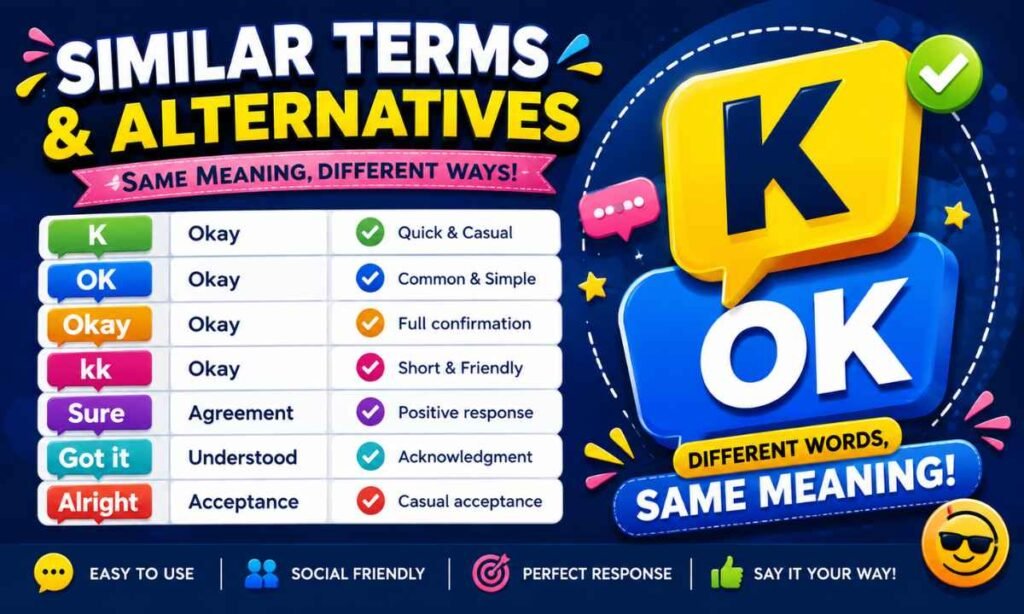
Beyond the core k meaning in text, plenty of related words exist, each carrying its own shade of tone.
| Term | Meaning | Tone |
| K | Okay | Neutral or cold |
| OK | Okay | Standard |
| Okay | Full confirmation | Friendly |
| kk | Okay | Casual and warm |
| Sure | Agreement | Polite |
| Got it | Understood | Professional |
| Alright | Acceptance | Relaxed |
Is It Offensive or Friendly?
K is not inherently offensive. Whether it lands as friendly or cold depends almost entirely on context.
Friendly Use
Quick confirmations, casual chats, and gaming messages are places where K reads as normal and low stakes.
Negative Use
During arguments or emotionally loaded conversations, a bare K is more likely to read as cold, especially with a period at the end.
Famous Quotes or Lines Using the Term
Internet culture has built a whole genre of jokes around this one letter. A common line making the rounds is that nothing kills a conversation faster than a lone K, and another suggests a K reply means it’s time to apologize.
Grammar or Linguistic Insights
From a linguistic standpoint, K functions as an abbreviation and a discourse marker, managing conversation flow rather than adding new information. It works like “okay” or “sure,” signaling agreement without elaborating. Texting culture favors shorter forms, and K trims a whole word into a single letter.
How to Respond to K
How you respond to the k meaning in text you just received usually depends on how it felt to you in the first place.
Friendly Responses
- “Cool 😄”
- “Thanks!”
- “Awesome”
If It Feels Cold
- “Everything okay?”
- “Did I say something wrong?”
Chat-Style Examples
- “I’m running late.” → “K, no worries”
- “We need to talk.” → “K…”
- “Can you send the file?” → “K, doing it now”
Differences From Similar Words
Small wording changes shift the tone of a reply.
K vs OK
OK feels slightly more complete and neutral than the bare letter K.
K vs kk
kk consistently reads as friendlier and more relaxed than a single K.
K vs Okay
Okay sounds more thoughtful and polite, since it takes extra effort to spell out.
K vs Sure
Sure signals active agreement, while K can come across as more passive.
Relevance in Online Conversations & Dating Apps
On dating apps, a bare K can hurt someone’s chances at keeping a conversation going. Many users read it as boredom rather than efficiency.
- “Want to meet this weekend?” → “K”
- “Want to meet this weekend?” → “Sounds fun, count me in”
The second reply comes across as more engaged, which matters in a setting built around first impressions.
Popularity & Trends Over Time
Interest in k meaning in text grew alongside SMS texting, chat rooms, and eventually smartphones and social apps. Interest spikes whenever people discuss dry texting online, and searches like “what does K mean from a girl” or “why is K rude” show up constantly nearby.
Frequently Asked Questions
These quick answers cover the most common searches people run about K meaning in text, straight from real Google queries.
What does K mean in text slang?
In text slang, K simply means okay, a fast way to confirm or acknowledge a message.
What does K mean in Gen Z slang?
Gen Z uses K the same way older generations do, though many prefer “kk,” emojis, or “bet” for a warmer tone.
What does K mean via text?
Via text, K works as shorthand for okay, and its tone shifts based on punctuation and context.
What does it mean if a girl texts K?
Usually it just means okay. In a tense chat, it might signal frustration, but context matters more than the letter.
What does K mean in WhatsApp?
On WhatsApp, K usually means okay or understood, a quick acknowledgment between people who already know each other.
Conclusion
The k meaning in text looks simple at first glance, since it is nothing more than a fast version of “okay.” Its real weight comes from tone, punctuation, and the relationship between the two people texting, not from the letter itself. From its roots in 1800s newspaper slang to its shortcut status during the SMS era, K has always been built around saving effort.
Across WhatsApp, Instagram, Snapchat, and dating apps, a bare K can still feel cold after a serious message, while “kk” or an emoji softens it. Most misconceptions, like K always meaning anger or a K ending a relationship, simply do not hold up once you look at real context. Understanding all of this turns a confusing one letter reply into something you can read and respond to with confidence.