
Casi algo meaning, put simply, is “almost something.” It’s a Spanish phrase used to describe a connection, usually romantic, that feels real and emotionally loaded but never becomes official. If you’ve seen it in a caption, heard it in a song, or had a friend text it to you after a confusing situationship ended, you already know the feeling before you know the words.
This guide breaks down what casi algo actually means, where it came from, and how people use it today across TikTok and everyday conversation. You’ll learn why it hits differently than an almost relationship, and what the psychology behind that “almost” feeling really looks like. By the end, you’ll understand the full emotional weight behind it, not just the definition.
What Does Casi Algo Mean?
Casi algo means “almost something” in English. It describes a connection that carries real emotional weight but never gets a label, a title, or a clear commitment.
Casi translates to “almost” or “nearly.” Algo translates to “something” or “anything.” Put together, casi algo captures a very specific texture of incompleteness. Not nothing. Not everything. Something that almost happened.
| Spanish Word | English Meaning | Example |
| Casi | Almost, nearly | Casi gané, meaning I almost won |
| Algo | Something, anything | Quiero algo, meaning I want something |
| Casi algo | Almost something | An emotional connection that never got a name |
Here’s the important part. Casi algo meaning in English isn’t just a literal translation exercise. Native and bilingual speakers use the phrase to name a very specific emotional state: strong feelings, real closeness, and zero clarity about what the relationship actually is. It sits in that gray zone between friendship and a real relationship, and that ambiguity is the entire point of the phrase.
Most people who search this term already understand the feeling. They just want the word for it.
The Origin of Casi Algo
The origin of casi algo is genuinely a bit contested, and most articles online skip right past that fact. There are two competing stories about where the phrase came from, and it’s worth being honest about both.
One version traces casi algo back to Mexican telenovelas in the 1990s, where writers used the phrase to describe characters trapped in unresolved romantic tension. This version has circulated online, but it doesn’t come with any verifiable source, script excerpt, or specific show attached to it.
The more commonly cited version places the phrase’s rise in Latin American youth culture during the early 2010s, particularly in Mexico, Colombia, and Spain. As dating apps changed how people met, and platforms like Instagram and later TikTok gave everyone a place to narrate their love lives, casi algo became shorthand for a very modern kind of ambiguity.
What’s clear is the timeline of its viral spread. By the mid-2010s, the term was showing up in YouTube relationship content and song lyrics. Music helped push it further into the mainstream, with tracks like Xavi’s “Tu Casi Algo” and Nivel’s “Casi Algo” giving the phrase emotional resonance that a dictionary definition never could. By the early 2020s, it had crossed language barriers entirely, showing up in bilingual Gen Z and Millennial slang across the internet.
So the honest answer is this: casi algo is rooted in everyday Spanish vocabulary, its use as a relationship term is a genuinely modern phenomenon, and its exact first appearance isn’t something anyone can point to with certainty. That’s a more accurate picture than most guides give you.
Casi Algo in Relationships: What It Looks Like in Real Life

In relationships, casi algo describes the space between casual talking and an official partnership, where both people act like a couple without ever naming it. It’s specific, and it’s far more common than most people realize.
Here’s what it typically looks like on the ground:
- You text every single day, sometimes for hours
- You go on dates, but neither of you calls them dates
- There’s real physical and emotional closeness
- Friends ask “so what are you two?” and nobody has an answer
- One or both people feel something deeper but never say it out loud
- The “what are we” conversation keeps getting postponed
It’s the talking stage that never graduates into anything official. It’s introducing someone as “a friend” while your actual feelings are doing something completely different. The connection is real. The definition just never arrives.
Real-Life Examples of Casi Algo
Seeing the phrase used in context makes the meaning click faster than any definition can.
“Somos casi algo” means “we are almost something.” People use this when they act like a couple in every way except the label.
“Ella fue mi casi algo” means “she was my almost something.” This past tense version usually shows up when someone is looking back on a connection that never became official.
“Mi casi algo me tiene loco” means “my almost something is driving me crazy.” This captures the specific confusion and longing that comes with not knowing where you stand.
The phrase “mi casi algo” carries extra intimacy because it points to one specific person, someone who mattered without ever formally claiming the role of partner.
Why Casi Algo Hits Different Than “Situationship”
Casi algo and situationship describe similar territory, but they don’t carry the same emotional charge. Situationship is a clinical, almost administrative word. Casi algo is poetic, and that difference matters to the people using it.
| Feature | Casi Algo | Situationship |
| Language origin | Spanish, Latin American slang | English, modern dating vocabulary |
| Tone | Warm, poetic, nostalgic | Neutral, descriptive |
| Emotional weight | Carries longing and hope | More detached, analytical |
| Common use | Music, captions, personal conversation | Dating advice, psychology content |
| What it conveys | “Almost something beautiful” | “An undefined romantic situation” |
English already has practical vocabulary for undefined relationships. What it doesn’t have is a word that captures the actual feeling of one, the hope, the second guessing, the tenderness mixed with frustration. That’s exactly why casi algo has caught on even among people who don’t speak Spanish. The word simply does more emotional work in fewer syllables.
Is casi algo a situationship? Functionally, yes, they overlap heavily. But casi algo usually implies deeper emotional investment and a sense that something real slipped away, while situationship can describe something more mutual and low stakes from the start.
The Emotional Psychology of a Casi Algo
Being in this kind of undefined connection is emotionally taxing because it creates real attachment without giving you any of the closure tools a normal breakup provides.
Psychologists describe this kind of unresolved emotional loss as ambiguous loss, a term for grief that has no clear ending and no social ritual attached to it. There’s no breakup conversation, no clean “we’re done,” just a slow fade or a sudden stop that leaves you grieving something nobody else acknowledges as real.
Part of what keeps people stuck is a pattern called intermittent reinforcement, where affection and closeness show up unpredictably instead of consistently. One day everything feels like it’s building toward something real. The next day, communication goes quiet. That inconsistency is what makes the connection feel addictive rather than simply confusing, and it’s a pattern researchers have studied in behavioral psychology for decades, well beyond dating.
Attachment style plays a role too. Someone with a more anxious attachment style may crave reassurance and read every text as meaningful, while someone with a more avoidant style may resist labels even when they’re genuinely invested. When those two styles collide, the mismatch in what each person needs can stretch the ambiguity out for months, with neither person fully able to name what’s happening.
This is why people often describe this experience as harder to move past than an actual breakup. There’s nothing official to point to, no clean ending to grieve, yet the emotional impact is very real. The ambiguity itself becomes part of the trap, since it’s easier to keep hoping than to admit that neither person is willing to commit out loud. Recognizing that pattern is often the first step toward actually getting unstuck from it.
Casi Algo Beyond Romance: Other Uses of the Phrase
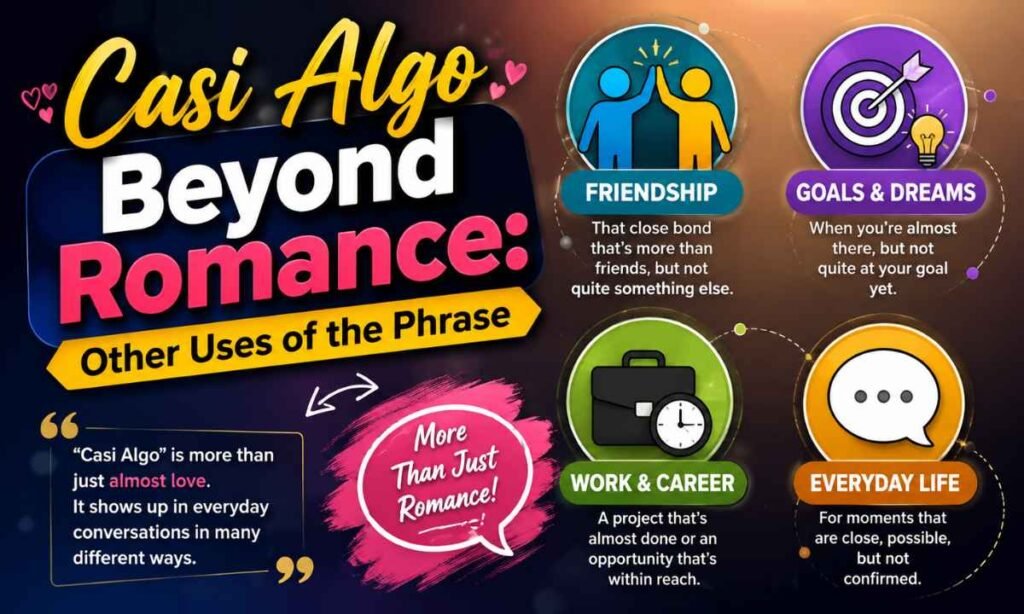
While romance is the most common context, the phrase isn’t limited to love. It describes any situation that felt close to meaningful but never fully arrived.
In a career context, it might describe a promotion that got hinted at for months but never materialized, or a job offer that felt certain right up until it wasn’t. That specific sting of professional near success has the exact same emotional shape as a romantic one, even though nobody talks about it in those terms.
In friendships, the same idea can describe a connection that almost deepened into something closer, two people who clicked in a way that felt significant, before life, distance, or bad timing got in the way before it became a real friendship worth keeping.
With dreams and goals, the phrase fits a project, a business idea, or a personal milestone that felt within reach and then slipped away. Anyone who has come close to a goal only to watch it dissolve understands this feeling without needing it explained, whether it happened at work, in school, or in a creative pursuit that never quite launched.
Across all these contexts, casi algo captures the same core feeling: the particular frustration of proximity without completion, of getting close enough to almost taste it.
Casi Algo on Social Media and in Pop Culture
This phrase has become a fixture of modern online culture, especially among Gen Z and Millennial users navigating dating apps and digital communication.
On TikTok, it shows up constantly. Casi algo meaning TikTok content typically includes storytelling videos about mixed signals, undefined connections, and the emotional aftermath of relationship limbo, often set to music for extra emotional effect. These videos rack up millions of views because the feeling is instantly recognizable, even to viewers who don’t speak Spanish.
On Instagram, people use it in captions, story slides, and Reels to describe their own romantic situations, sometimes with humor, sometimes with real vulnerability. It’s become a kind of emotional shorthand that doesn’t need further explanation among younger audiences.
In Spanish language music, the concept shows up frequently in songs about love that almost happened, love that got interrupted by hesitation rather than conflict. That musical connection is part of why the phrase carries such emotional resonance rather than sounding clinical.
Even meme culture has picked it up. Posts joking about having “zero relationships and three casi algos” go viral because they name a shared, very modern experience. If you search casi algo meaning urban dictionary, you’ll find user submitted definitions that echo the same core idea: a failed talking stage, a connection that was more than friendship but never became official.
The reach of this phrase across languages suggests the feeling behind it isn’t cultural, it’s simply human. People recognize it immediately because most of them have lived through some version of it, whether or not they ever had a word for it before.
How to Navigate a Casi Algo Situation

If you’re currently stuck in an undefined connection, the way out starts with naming the situation honestly and then choosing to act instead of waiting.
Name what you’re actually feeling. Acknowledge to yourself that the connection matters and that the lack of clarity is genuinely affecting your wellbeing. Pretending it doesn’t bother you rarely makes it hurt less.
Have the direct conversation. Hints and subtle signals almost never move things forward on their own. Something as simple as asking “what are we actually building here” opens the door that vague texting never will.
Set a personal timeline. Decide privately how long you’re willing to stay in the undefined zone, and hold yourself to that boundary even when the connection still feels exciting.
Pay attention to actions, not just words. Someone who genuinely wants to be with you will find consistent ways to show it. Consistency tells you more than any late night text ever could.
Protect your emotional wellbeing first. If the casi algo is creating more anxiety than joy, that’s useful information about whether it’s worth continuing to hold onto.
Romantic ambiguity can feel exciting at the start, almost like a slow burn worth waiting for. But it has a shelf life. Eventually, clarity becomes the healthier choice for everyone involved, and choosing it usually feels less scary once you actually say it out loud.
It also helps to remember that asking for clarity isn’t the same as demanding a commitment someone isn’t ready to make. You’re simply asking to know where you actually stand, which is a reasonable thing to want from anyone you’re spending real emotional energy on.
Frequently Asked Questions
What does casi algo mean in slang?
Casi algo means an almost relationship. Two people feel emotionally close and act like a couple but never make it official.
Is casi algo a situationship?
Similar but not identical. Casi algo usually carries more emotional weight and longing than a typical, lower stakes situationship.
What does casi algo mean in English?
It translates to “almost something.” It describes a connection that feels real but never receives a clear label or commitment.
What does casiago mean?
Casiago isn’t a real word. It’s a common misspelling of “casi algo,” the Spanish phrase meaning “almost something.”
What does “algo” mean in slang?
Algo simply means “something” or “anything” in Spanish. It only gains its relationship meaning when paired with “casi.”
Conclusion
Casi algo meaning comes down to this: two ordinary Spanish words, casi and algo, joined together to name a connection that felt real but never became official. From its contested origin story to its rise on TikTok and in Spanish music, the phrase captures something English never quite could, the hope, the ambiguity, and the ache of “almost.”
Whether you’re currently living through a casi algo, processing one that already ended, or simply searching for the word that finally describes your situation, understanding it does something useful. It validates the feeling, gives it a name, and reminds you that “almost something” is one of the most universally human experiences there is.