Poison tree tattoo meaning centers on one powerful idea: anger that never gets spoken out loud doesn’t disappear, it grows roots. This design has quietly become one of the most emotionally layered choices in modern body art. It pulls directly from a single poem that’s stayed relevant for more than two centuries.
The poison tree tattoo carries real literary weight, tied to William Blake’s 1794 poem “A Poison Tree.” It speaks to something almost everyone has felt: swallowing anger instead of saying it out loud. Understanding the full poison tree tattoo meaning before you commit can change how you see this design forever.
Poison Tree Tattoo Meaning in Simple Terms
In plain language, the poison tree tattoo meaning is this: anger you don’t express doesn’t disappear, it grows. The design pictures that growth as a twisted, dark tree, sometimes bearing fruit that looks tempting but carries consequence. It’s less about hating someone and more about what happens inside you when you swallow the hurt instead of dealing with it.
What Is a Poison Tree Tattoo?
A poison tree tattoo is a symbolic design showing a dark, often gnarled tree, usually stripped of the softness you’d expect from a normal nature tattoo. Instead of full leaves and open branches, you’ll typically see bare limbs, twisted bark, and sometimes a single glowing piece of fruit hanging in the middle of it all.
It’s not meant to be pretty in the traditional sense. The visual roughness is the point. Every crooked branch and shadowed root is standing in for something emotional that grew when it should have been let go instead.
At its core, a poison tree tattoo works as a warning and a mirror at the same time. It tells a story about what silence does to anger, and it asks the wearer to look honestly at their own patterns. That’s the simplest way to describe the poison tree tattoo meaning without any of the literary detail attached.
The Origins: William Blake’s “A Poison Tree” (1794)
Understanding the poison tree tattoo meaning starts with its source material. It traces directly back to English poet William Blake, who published “A Poison Tree” in 1794 as part of his collection Songs of Experience. This single fact is the anchor for nearly every version of the tattoo that exists today.
The poem opens with a contrast most readers recognize instantly. Blake writes that anger toward a friend, once spoken, fades. Anger toward a foe, kept hidden, doesn’t. Instead, it’s nursed in secret, watered with fear, and dressed up with false smiles until it grows into something with real weight.
That growth becomes a tree. The tree produces an apple, bright and inviting on the outside. The narrator’s enemy eventually steals into the garden at night, eats the fruit, and dies. Four short stanzas carry a full emotional arc: a seed of resentment, secret cultivation, a tempting result, and a fatal consequence.
Poison Tree Tattoo Meaning: Core Symbolism
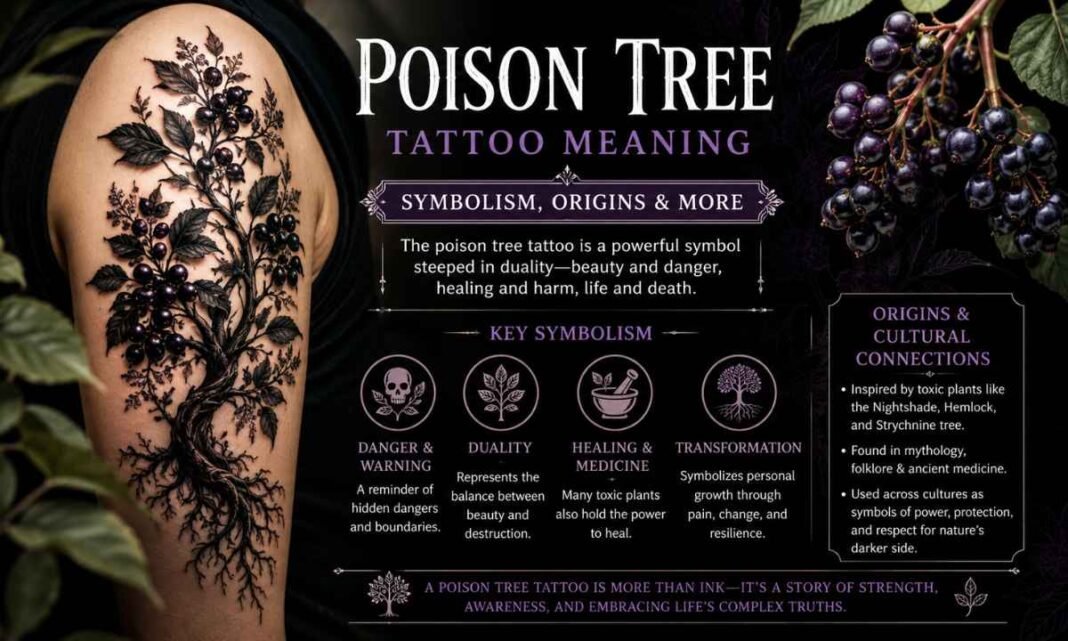
The core meaning behind a poison tree tattoo isn’t a single idea. It’s a cluster of related emotional themes that wearers draw from depending on their own experience.
| Symbol Element | What It Represents |
| Twisted branches | Anger that’s grown misshapen from being held in |
| The poisoned apple | Consequences that follow silence and buried resentment |
| Bare or dying leaves | Emotional exhaustion or loss |
| Deep, gripping roots | Long-held grudges or old wounds |
| New growth beside the tree | Healing that happens after confronting the pain |
| Serpent motifs | Betrayal or temptation tied to the situation |
What makes this tattoo genuinely different from most dark tattoo concepts is that it doesn’t glorify anger. It exposes it. Choosing this design usually means the wearer has already sat with their own capacity for resentment and decided it deserved acknowledgment rather than denial.
Who Gets a Poison Tree Tattoo — and Why
The poison tree tattoo meaning tends to attract people who have recognized a pattern of bottling emotion and want a permanent reminder not to repeat it. It’s rarely an impulse pick.
A common thread among wearers is growing up in households where anger wasn’t safe to express openly. Smiling through frustration became a habit long before it became a tattoo idea.
Survivors of betrayal, whether romantic, family related, or professional, are another large group. For them, the tattoo marks both the damage that happened and the decision to move past it rather than stay stuck in it.
Literature lovers and fans of dark romanticism gravitate toward it too, since Blake’s short, sharp verse fits naturally alongside other gothic and emotionally complex art. And a growing number of people get a poison tree tattoo specifically as a marker of therapy or emotional recovery work, using the tree as proof they finally chose honesty over silence.
Poison Tree Tattoo Meaning for Women and Men
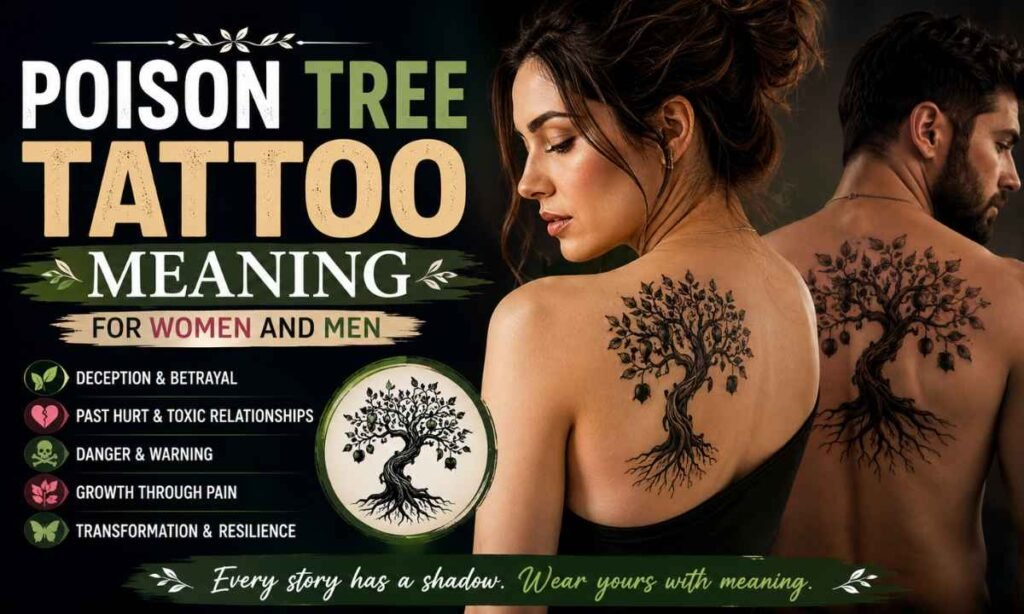
The underlying meaning doesn’t change based on gender. What tends to shift is how the design gets styled and what specific experience it’s tied to.
Poison Tree Tattoo Meaning for a Girl
For many women, this design leans toward resilience after a toxic relationship or family conflict. Softer styles like fine line work or watercolor shading are common choices, often paired with birds in flight or open branches to signal independence and moving forward.
Poison Tree Tattoo Meaning for Men
Men more often frame the design around emotional control rather than survival. It becomes a personal reminder to confront anger directly instead of letting it simmer, which mirrors Blake’s original warning almost exactly.
Neither pattern is a rule. Plenty of wearers cross these lines, and the poison tree tattoo meaning stays valid either way.
Poison Tree Tattoo Meaning in the Bible
Some wearers connect this design to scripture rather than, or alongside, Blake’s poem. The Bible speaks about buried anger more than once, and the language lines up closely with the tattoo’s imagery.
Proverbs 14:30 notes that a heart at peace gives life to the body, while envy rots the bones. Hebrews 12:15 warns against letting a “root of bitterness” spring up and cause trouble. Both passages describe hidden resentment in almost the same botanical terms Blake used centuries later.
For believers, the poison tree tattoo meaning becomes a scripture-rooted reminder to release anger before it spreads, rather than a purely literary reference.
Poison Tree vs Tree of Life: What Does a Tree Tattoo Symbolize?
Tree tattoos in general tend to symbolize growth, family, strength, or connection to something larger than yourself. The poison tree flips that meaning on purpose, which is exactly why people confuse the two designs before researching them.
| Feature | Poison Tree Tattoo | Tree of Life Tattoo |
| Core meaning | Suppressed anger, consequence | Growth, family, connection |
| Origin | William Blake’s poem | Multiple mythologies and faiths |
| Tone | Dark, cautionary | Hopeful, expansive |
| Common elements | Apple, serpent, bare branches | Roots, birds, sun, full canopy |
| Best fit for | Marking a specific wound or betrayal | Celebrating growth or heritage |
If your story is closer to overcoming hardship in general, the tree of life may say it better. If you’re marking a specific emotional wound, the poison tree stays the more accurate choice.
Popular Design Variations
The poison tree tattoo isn’t a single fixed image, and the poison tree tattoo meaning can shift slightly depending on which variation you choose. Artists and wearers bring a lot of creativity to how the concept gets expressed.
Black and Grey Gothic Style
Twisted, leafless branches and deep shadow work define this version. It’s the most traditional take, often paired with ravens or a full moon for extra atmosphere.
Blake-Inspired Illustration
Some wearers work actual lines from the poem into the design, etched along the trunk or beneath the roots. This makes the literary connection explicit rather than implied.
Half-Dead, Half-Living Tree
One side blooms while the other decays. This variation captures duality directly, showing healing and pain existing in the same piece rather than one replacing the other.
Serpent and Fruit Motif
A snake coiled around the branches next to a glowing apple nods to both Blake’s poem and the Garden of Eden story, layering literary and biblical meaning together.
Heartfruit Design
Here the forbidden fruit takes the shape of a heart, shifting the focus toward love that turned harmful rather than anger in general.
Minimalist Line Art
A sparse, simple outline of a bare tree. This version carries the same symbolism without the heavy visual weight, popular with people who want subtlety.
Watercolor Style
Soft, blended color trades gothic heaviness for emotional intensity. Deep reds and inky blacks give this style a raw, alive feeling despite the dark theme, and it’s a popular pick for wearers who want the poison tree tattoo meaning without a heavy gothic look.
Color Meanings in Poison Tree Tattoos
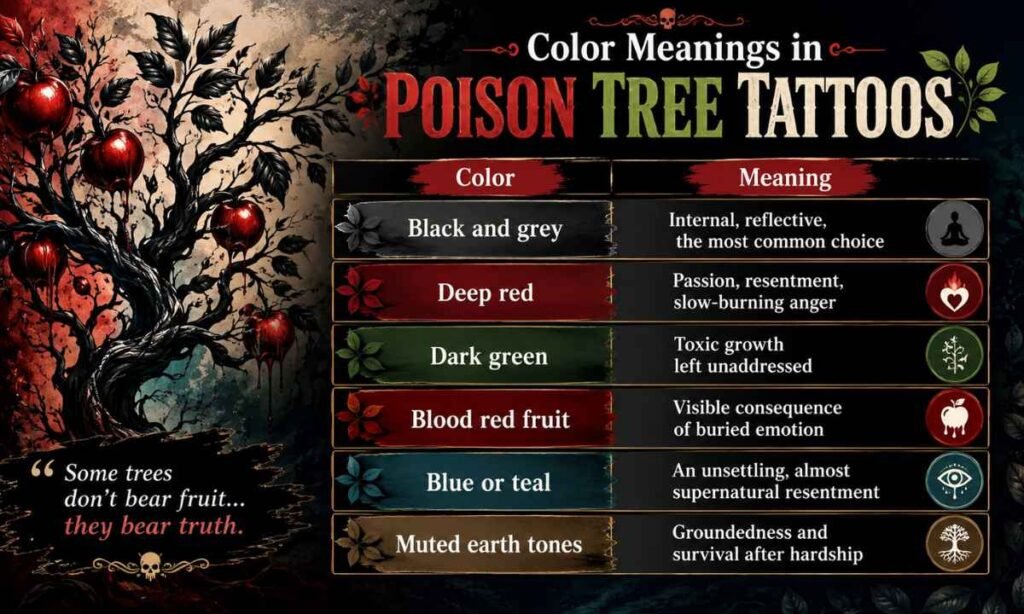
Color changes how the poison tree tattoo meaning reads at a glance, sometimes as much as the design itself.
| Color | Meaning |
| Black and grey | Internal, reflective, the most common choice |
| Deep red | Passion, resentment, slow-burning anger |
| Dark green | Toxic growth left unaddressed |
| Blood red fruit | Visible consequence of buried emotion |
| Blue or teal | An unsettling, almost supernatural resentment |
| Muted earth tones | Groundedness and survival after hardship |
Most people stick with black and grey because it keeps the tone serious without pulling focus away from the symbolism itself.
Best Placement Options for a Poison Tree Tattoo
Placement adds its own layer to the poison tree tattoo meaning, since visibility often mirrors how open the wearer is about their story.
| Placement | What It Communicates | Pain Level |
| Forearm | Openness, not hiding the story | Moderate |
| Back | A large statement piece | Moderate |
| Ribs | Private, personal, meant for you | Higher |
| Chest | Emotional weight close to the heart | Higher |
| Spine | Strength rising from the core | Higher |
| Thigh or calf | Grounded, easy to reveal or cover | Lower |
| Wrist or ankle | A subtle, quiet reminder | Lower to moderate |
The forearm remains the most requested spot. It stays visible to you daily and to others in most situations, which fits the idea of facing your story rather than hiding it. Pain tolerance varies a lot person to person, so treat this table as a general guide and confirm specifics with your artist.
Psychological Dimension: Why This Symbol Resonates So Deeply
The poison tree tattoo meaning resonates because modern psychology backs up what Blake wrote by instinct over two centuries ago. Chronic emotional suppression has been linked repeatedly to anxiety, tension, and physical stress on the body, not just discomfort in the moment.
Carl Jung’s concept of the shadow self, the parts of ourselves we bury or deny, maps almost exactly onto this design. Jung argued that acknowledging the shadow rather than pretending it doesn’t exist is the first real step toward psychological wholeness. That’s precisely what this tattoo does on skin.
There’s also a mental health angle worth naming directly. Some therapists reference the poem when discussing emotional repression with clients, since it gives a concrete image for an abstract pattern.
Which Tattoo to Avoid If You Want This Meaning to Land
If the point of your tattoo is specifically the poison tree tattoo meaning, avoid designs that blur it with unrelated tree symbolism. A generic dead tree without any fruit, roots, or serpent detail can easily read as just decay or loss rather than suppressed anger specifically.
Avoid combining it with full tree of life elements like a wide, sun-lit canopy, since that visually contradicts the cautionary tone you’re going for. Also be cautious with overly cartoonish poison symbols, like skull and crossbones fruit, since they can push the design toward horror aesthetic instead of the emotional depth the symbol is meant to carry.
Frequently Asked Questions
What does tattoo poison tree mean?
A poison tree tattoo means hidden anger and resentment that grows when never expressed, drawn from William Blake’s 1794 poem “A Poison Tree.”
What does a poison tattoo mean?
Poison imagery in tattoos represents danger disguised as something appealing, toxic influence, or a warning about hidden harm building beneath the surface.
What does a tree tattoo symbolize?
Most tree tattoos symbolize life, growth, family, or strength. The poison tree is a deliberate exception, symbolizing decay from suppressed emotion.
Which tattoo to avoid if you want this meaning to land?
Avoid a bare dead tree with no fruit, roots, or serpent detail, since it reads as simple loss rather than suppressed anger specifically.
What is the poison tree tattoo meaning in the Bible?
It echoes Proverbs 14:30 and Hebrews 12:15, both warning that a hidden “root of bitterness” causes harm if left unaddressed.
Conclusion
The poison tree tattoo meaning goes far beyond a dark aesthetic choice. Rooted in William Blake’s 1794 poem and layered with biblical, psychological, and personal symbolism, it speaks to anyone who has felt the slow weight of anger they never said out loud. From its literary origins to its many design variations, colors, and placements, this tattoo carries a story that’s as personal as it is universal.
It isn’t a design people choose for the sake of looking edgy. It’s chosen by people who understand exactly what silence costs and who’ve decided to mark that lesson permanently. Whether you read it as a warning, a memorial, or proof of your own growth, the poison tree tattoo carries a meaning that only gets more honest with time.