GIF meaning is one of the most searched terms by people who receive animated images in chats and wonder what they actually represent. Ever received a GIF in a chat and paused for a second, wondering what it actually means? You’re not alone. Millions of people search for the GIF meaning every day, whether it’s the technical definition or what a friend meant by sending one.
In this guide, you’ll learn what GIF stands for, how to pronounce it correctly, and what a GIF really means in texting, WhatsApp, and social media chats. We’ll also cover real examples so you never have to guess again.
GIF Meaning: Quick Answer
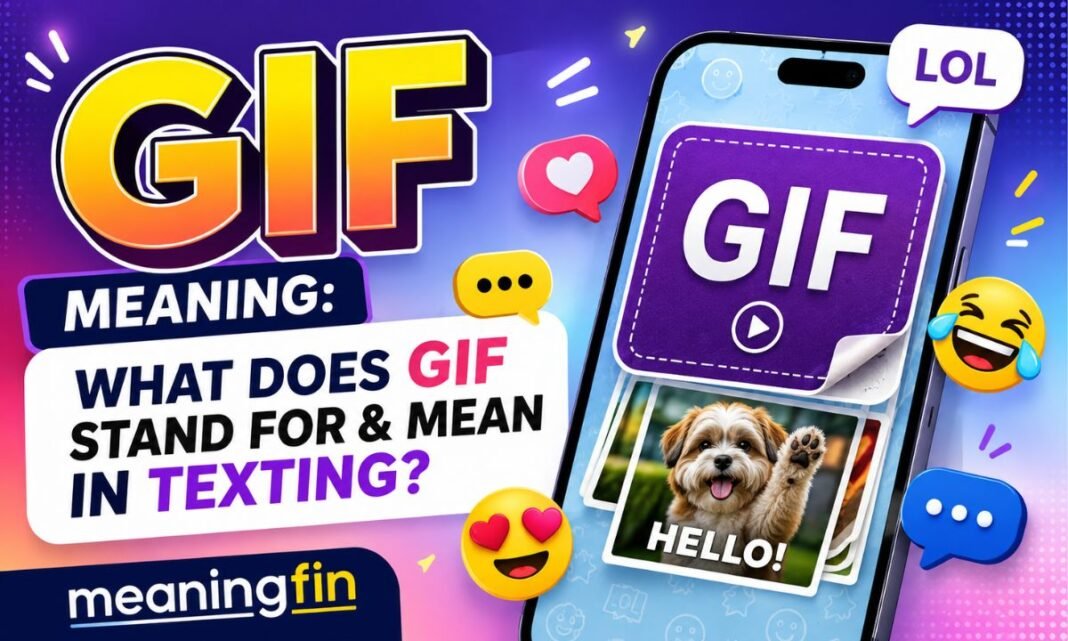
GIF stands for Graphics Interchange Format.
It’s a digital image format that supports both still and animated pictures. In everyday chats, though, a GIF usually means a lot more than a file type.
People send GIFs to:
- React to a message
- Show emotion without typing
- Add humor to a conversation
- Reply faster than words allow
Think of a GIF as a visual reply that stands in for a sentence.
What Is a GIF?
A GIF is a short animated image that loops on its own, without sound.
Unlike a video, a GIF usually plays for just a few seconds before repeating. You’ve probably seen ones like a person clapping, a cat yawning, or a celebrity making a funny face.
A quick note on terminology: technically, a GIF is a file format, not a photo or a video. But once that file is animated and shared in a chat, most people just call the whole thing “a GIF” or “an image,” and that’s completely fine in everyday use.
So in simple terms: a GIF is a small looping animation used to react, express, or entertain — online.
What Does GIF Stand For?
GIF is short for Graphics Interchange Format.
It was created by computer scientist Steve Wilhite while working at CompuServe in 1987. At the time, the goal was simple — build an image format small enough to load quickly on the slow internet connections of that era.
The technical meaning hasn’t changed since. What has changed is how people use the word — today “GIF” usually means a short animated reaction, not a raw file format.
GIF Full Form: Graphics or Graphical Interchange Format?
You’ll sometimes see two versions floating around online: “Graphics Interchange Format” and “Graphical Interchange Format.”
The correct, official full form is Graphics Interchange Format. This is confirmed by both the original CompuServe specification and Merriam-Webster’s dictionary entry. “Graphical” is a common misquote that has spread simply because it sounds more natural in casual speech — but it isn’t accurate.
If you’re citing the full form anywhere, “Graphics Interchange Format” is the one to use.
Why Do They Call It a GIF?
The name comes directly from what the format does: it lets computers interchange — meaning share — graphics files easily, in a smaller size than most image formats at the time.
Steve Wilhite and his team at CompuServe needed a name that described the function of the format, not a brand name. “Graphics Interchange Format” did exactly that, and the short form “GIF” stuck.
GIF Pronunciation: Is It “Gif” or “Jif”?
This is one of the internet’s longest-running debates.
- Hard G (“gif,” like “gift”) — the pronunciation most people naturally use, since the word starts with “graphics.”
- Soft G (“jif,” like “gem”) — the pronunciation Steve Wilhite, the format’s creator, always insisted was correct.
Wilhite even joked about it while accepting a Lifetime Achievement Webby Award, using his acceptance speech to say the word should be pronounced “jif.”
Here’s the honest answer: both pronunciations are widely accepted today. Major dictionaries, including Merriam-Webster, list both as correct. So whichever way you say it, you won’t be wrong.
Why Are GIFs So Popular?
Plain text can feel flat. A one-word reply like “okay” can come across as friendly, bored, or annoyed — and the reader can’t always tell which one you meant.
GIFs fix that problem by adding:
- Emotion
- Humor
- Tone
- Personality
Instead of typing “that’s hilarious,” you can send a laughing GIF. Instead of writing “I’m so excited,” a dancing GIF says it faster — and often funnier.
That instant, visual reaction is exactly why GIFs became such a big part of how people talk online.
What Does GIF Mean in Texting?
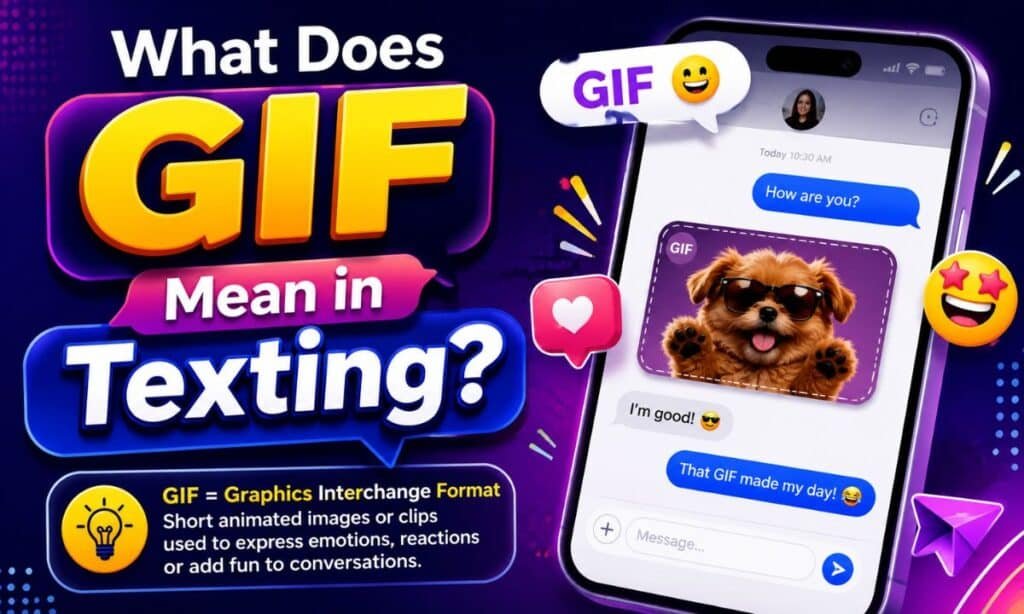
When someone searches “what does GIF mean in texting,” they’re usually asking what the sender is trying to say without words.
In a text conversation, a GIF is normally used as:
- A quick reaction
- A joke
- An emotional response
- A way to keep the conversation light
Example:
Friend: I finally got the job! You: (sends a cheering GIF)
That GIF means: “Congratulations, I’m genuinely happy for you” — without a single word typed.
Here’s a quick reference for common GIF types and what they usually mean in a text:
| GIF Type | Common Meaning |
| Laughing GIF | That’s funny |
| Clapping GIF | Good job / well done |
| Heart GIF | Affection or appreciation |
| Eye-roll GIF | Annoyance or sarcasm |
| Hugging GIF | Support or comfort |
| Shocked GIF | Surprise or disbelief |
GIF Meaning in Chat Apps
GIFs are especially common on messaging platforms because they let people react without breaking the flow of a conversation.
You’ll see them regularly on:
- Messenger
- Telegram
- iMessage
- Discord
- Signal
Most of these apps have a built-in GIF search, usually powered by GIPHY, so users can find the right reaction in seconds instead of typing a reply.
GIF Meaning in WhatsApp
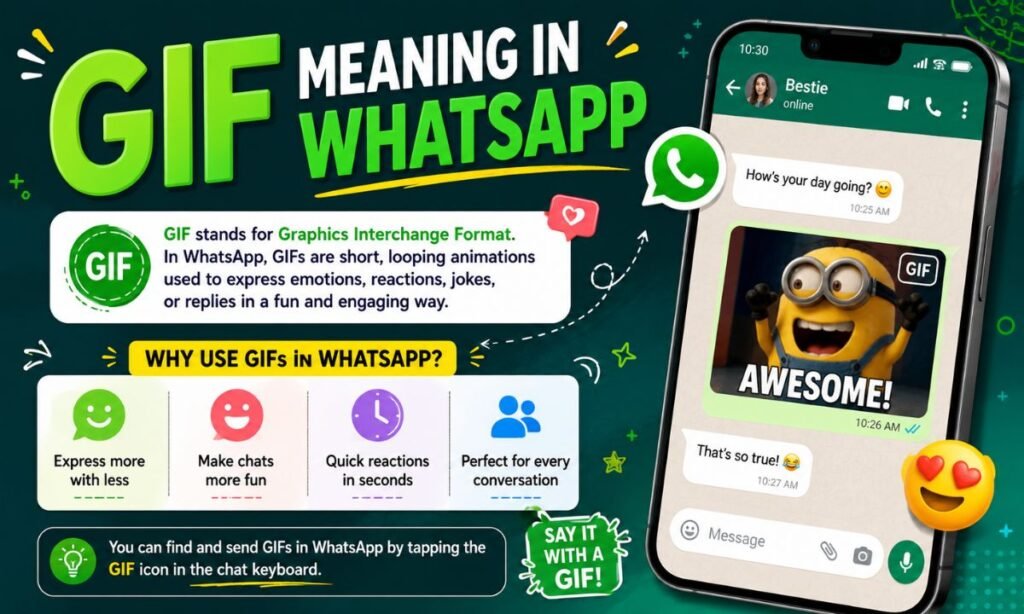
On WhatsApp specifically, GIFs are used to keep chats fun and expressive.
Common reasons people send GIFs on WhatsApp include:
- Celebrating good news
- Reacting to a joke
- Showing excitement about photos or updates
- Expressing sympathy or support
Example: A friend sends holiday photos, and you reply with a “wow” GIF instead of typing “that looks amazing.” The GIF gets the reaction across instantly.
What Does GIF Mean on Social Media?
Across platforms like Instagram, X (formerly Twitter), Facebook, and Reddit, GIFs work as quick, shareable reactions to posts, comments, and trending moments.
People commonly use them to react to:
- Funny posts
- Sports highlights
- Celebrity news
- Viral trends
- Breaking news
A single reaction GIF can express shock, excitement, disbelief, or humor — all without typing anything at all. On busy platforms, that speed is exactly why GIFs are so common in comment sections.
What Does GIF Mean From a Girl?
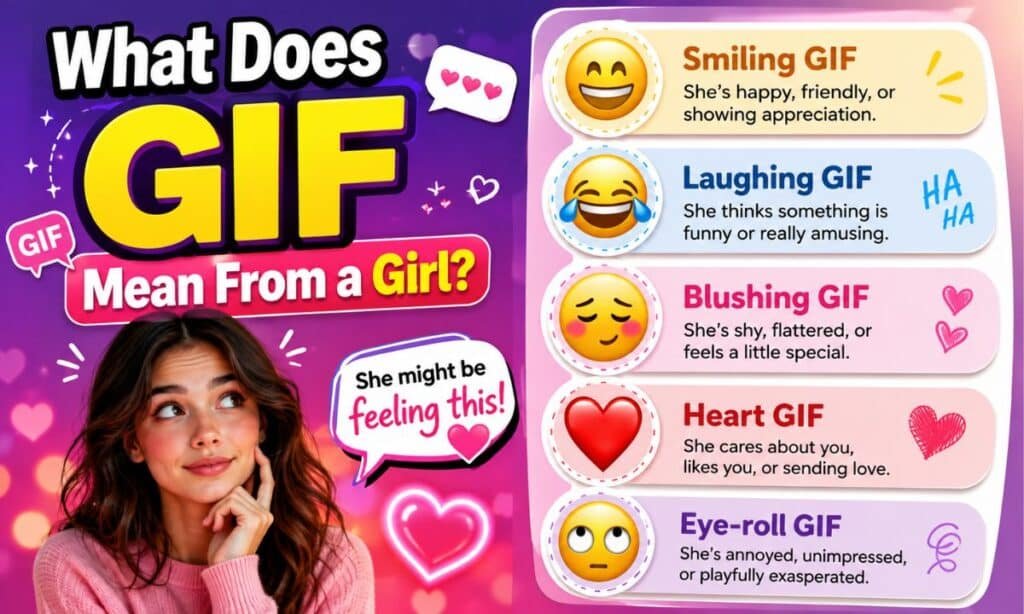
A GIF doesn’t have one fixed meaning — it depends on the conversation, your relationship, and the specific GIF sent.
That said, here are some common patterns:
| GIF Sent | Likely Meaning |
| Smiling GIF | Friendly, happy, or interested |
| Laughing GIF | She found something genuinely funny |
| Blushing GIF | Playful, shy, or possibly flirty |
| Heart GIF | Affection or appreciation |
| Eye-roll GIF | Teasing or mild annoyance |
For example, if you say “I forgot my keys again” and she replies with a laughing GIF, she’s most likely finding the situation funny — not being sarcastic. Always read the GIF alongside the conversation, not on its own.
What Does GIF Mean From a Guy?
The same rule applies here — a GIF from a guy usually reflects the emotion shown in the animation itself.
Common examples:
- Thumbs-up GIF — agreement or approval
- Laughing GIF — he found it funny
- Celebration GIF — excitement or congratulations
- Facepalm GIF — frustration or disbelief
Most of the time, there’s no hidden meaning — the GIF is simply a faster way of saying what it shows.
What Does This GIF Mean?
If someone sent you a specific GIF and you’re unsure what they meant, the honest answer is: it depends on context.
A crying GIF, for example, could mean:
- Genuine sadness
- Feeling emotional
- Laughing so hard they’re crying
- Playful, exaggerated drama
The safest way to understand a confusing GIF is to look at the message right before it and the overall tone of the conversation. GIFs are meant to add emotion to words — not replace the need for context entirely.
GIF Meaning in Slang
Technically, GIF isn’t slang — it’s a real file format. But in casual conversation, people use the word almost like slang.
Examples of how it’s used casually:
- “Send me a GIF.”
- “That GIF is literally me right now.”
- “I have the perfect GIF for this.”
In this informal sense, a GIF simply means a funny, relatable, or emotional reaction image — used the same way someone might use an expression like “mood” or “same.”
What Is GIPHY?
GIPHY isn’t a slang term — it’s a platform.
GIPHY is one of the largest online libraries of GIFs. Apps like WhatsApp, Instagram, Discord, and Facebook Messenger often use GIPHY’s search feature so users can quickly find and send a GIF without leaving the chat.
So if someone mentions “GIPHY,” they’re talking about the source of the GIF — not giving it a special meaning of its own.
Technical Meaning of GIF
Beyond everyday chat use, GIF has a specific technical definition worth knowing:
- Full form: Graphics Interchange Format
- File extension: .gif
- Introduced: 1987
- Supports: Both static and animated images
- Sound: None — GIFs never include audio
- Compression: Lossless, meaning image quality isn’t lost when the file size shrinks
Even with newer formats like WebP and MP4 available today, GIF remains one of the most widely recognized and supported image formats on the internet.
A Brief History of GIFs
The GIF format was introduced by CompuServe in 1987, years before social media existed. Its original purpose was simple: let users share images efficiently over slow, early internet connections.
It wasn’t until later that internet users discovered GIFs could be animated by combining several images into a short loop. That single idea turned a technical file format into one of the internet’s most recognizable ways to express emotion.
Today, GIFs are shared billions of times across chats, forums, and social platforms every single day.
Common Situations Where People Use GIFs
GIFs fit naturally into almost any casual conversation. Here are some everyday examples.
Celebrating Good News
Friend: I got the promotion! You: (sends a celebration GIF)
Reacting to Something Funny
Friend: I wore two different shoes to work today. You: (sends a laughing GIF)
Showing Support
Friend: I’m having a rough day. You: (sends a comforting hug GIF)
Expressing Shock
Friend: Guess who just won the lottery? You: (sends a shocked GIF)
These small moments are exactly why GIFs have become such a natural part of digital conversation.
When to Use GIFs
GIFs work best in relaxed, informal settings — but not every situation is a good fit.
Good Times to Use GIFs
- Text messages
- WhatsApp or Messenger chats
- Social media comments
- Group chats
- Casual conversations with friends
Times to Avoid GIFs
- Professional emails
- Job applications
- Business proposals
- Formal workplace discussions
- Serious or urgent conversations
Using GIFs in the right setting keeps a conversation fun. Using them in the wrong one can come across as unprofessional.
GIF vs Emoji vs Meme vs Sticker
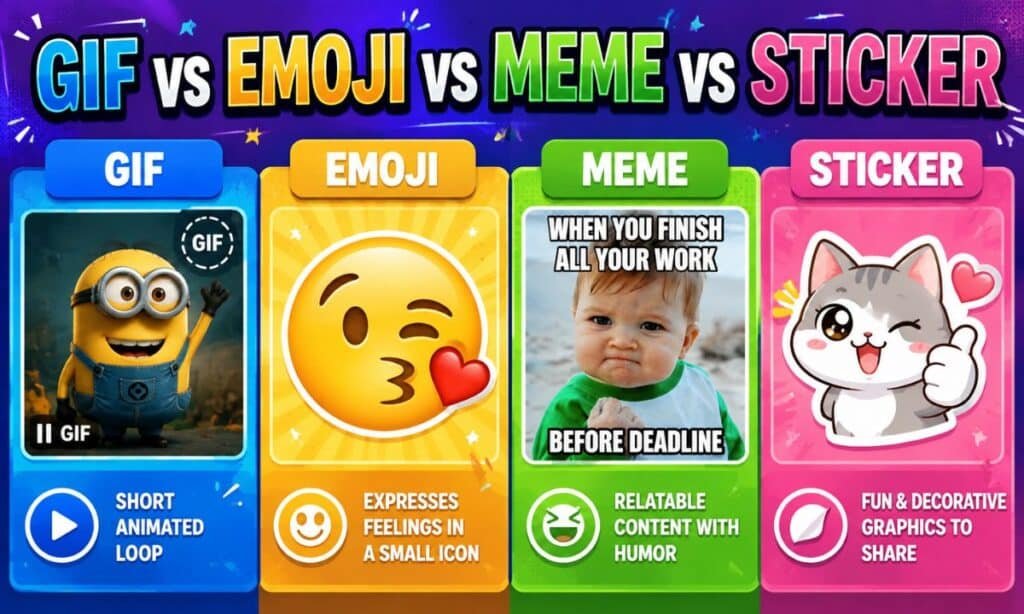
These formats are often used together, but they aren’t the same thing.
| Format | What It Is | Best Used For |
| GIF | Short looping animation | Reactions and emotional responses |
| Emoji | Small static symbol | Quick, simple reactions |
| Meme | Image, video, or joke format | Humor and shareable content |
| Sticker | Decorative static or animated image | Casual, personal-style chats |
A meme can technically be a GIF, but not every GIF is a meme — the difference is that memes are usually built around a joke or cultural reference, while GIFs are simply short animations that may or may not be humorous.
Are GIFs Still Popular in 2026?
Yes — GIFs remain a major part of online communication, though the way they’re delivered has been shifting. In mid-2026, several major platforms adjusted how they source GIFs after changes to third-party GIF APIs affected services like X and Discord, according to reporting from Ars Technica.
Despite these behind-the-scenes changes, GIFs themselves haven’t gone anywhere. They’re still one of the fastest ways to react, celebrate, or joke in a conversation — and platforms continue investing in keeping GIF search and sharing available to users.
Frequently Asked Questions
Why do they call it a GIF?
It’s named after what it does — the format lets computers “interchange” (share) “graphics” files in a small size. Graphics Interchange Format was shortened to GIF.
Is it pronounced “GIF” or “JIF”?
Both are commonly used. The format’s creator, Steve Wilhite, preferred the soft “jif” pronunciation, but dictionaries recognize the hard “gif” pronunciation as correct too.
What does it mean when someone sends you a GIF?
It usually means they’re reacting to your message with an emotion or joke instead of typing a reply. The exact meaning depends on the GIF and the conversation around it.
What’s a GIF on WhatsApp?
It’s a short looping animation you can send in a chat to react, celebrate, or add humor — similar to how it’s used on any other messaging app.
What is a GIF in texting?
In texting, a GIF is an animated image used to express a reaction, feeling, or joke faster than typing a full reply.
Conclusion
A GIF started out as a simple file format in 1987, but today it means so much more. Whether it’s the technical Graphics Interchange Format or a quick reaction sent to a friend, a GIF is really just a faster, more expressive way to communicate.
Next time you send or receive a GIF, you’ll know exactly what it means — both technically and in the conversation itself.