Someone texted you “ik” and you’re not sure what to make of it. Is it agreement? Is it dismissive? You just need a straight answer.
IK meaning is simple: it stands for “I know.” But its tone can shift a lot depending on where and how it’s used.
This guide breaks down what IK means across chat, WhatsApp, and social media. You’ll also learn how it differs from IKR and IDK, and exactly how to reply to it.
What Does IK Mean? (Definition)
IK means “I know.” It’s a texting abbreviation used to show you already understand or agree with something.
People type “ik” instead of the full phrase because it’s faster. It works as a complete reply on its own — no extra words needed.
For example:
The meaning stays the same in both cases, but the tone doesn’t. The first “ik” shows excitement. The second sounds more like mild annoyance.
That’s the tricky part about IK. The letters never change, but the feeling behind them depends entirely on context, punctuation, and who’s saying it.
You’ll mostly see it written in lowercase (“ik”) in casual texting, though “IK” and “Ik” are also common. It’s rarely used in formal or professional writing.
Origin of IK
IK isn’t new slang. It’s actually one of the earliest internet abbreviations, dating back to the early 2000s chatroom and instant messenger era.
Back then, typing was slow and character limits were strict. Shortcuts like “ik” let people say “I know” without wasting keystrokes.
As texting and social media grew, the habit stuck. Even though typing is much faster today, short forms like IK remain part of everyday online language.
It grew up alongside its opposite, IDK (“I don’t know”). Both abbreviations spread quickly because they cover two of the most common responses in any conversation — knowing something, or not.
Today, IK isn’t limited to any one platform or age group. It shows up in texts, DMs, comments, and casual chats across the internet, simply because it’s quick and universally understood.
IK Meaning in Chat, WhatsApp, Instagram & Other Platforms
IK means the same thing everywhere — “I know.” What changes slightly is how it’s used depending on the platform.
| Platform | Common Usage |
| WhatsApp / SMS | Direct, quick acknowledgment in personal chats |
| Often paired with emojis for emphasis, e.g. “ik 😭” | |
| TikTok | Used in comments to relate to a video or trend |
| Snapchat | Casual replies to snaps or chats |
| Discord | Common in fast-moving group chats and gaming |
On every platform, the core meaning holds. The difference is tone — emojis, capital letters, and punctuation do the work that facial expressions would do in person.
A plain “ik” can feel neutral. “IK!!” feels excited. “ik.” with a period can feel a little flat or dismissive. Reading the whole message, not just the abbreviation, tells you which one you’re getting.
Does Punctuation or Emoji Change IK’s Tone?
Yes — punctuation and emojis change how “ik” comes across, even though the words behind it never change.
| Style | Likely Tone |
| ik | Neutral or casual |
| IK! or ik!! | Excited, enthusiastic agreement |
| ik… | Dismissive, bored, or annoyed |
| ik 😭 / ik 😂 | Playful or relatable |
| IK, thanks for reminding me | Polite, softened acknowledgment |
A single “ik” with no punctuation can be read either way, which is why context matters more than the letters themselves. If a conversation has been friendly, “ik” is almost always harmless.
If someone seems irritated already, the same “ik” can read as short and dismissive. When in doubt, look at the rest of the conversation before assuming a tone that isn’t there.
IK Meaning in Chat: From a Girl vs From a Guy
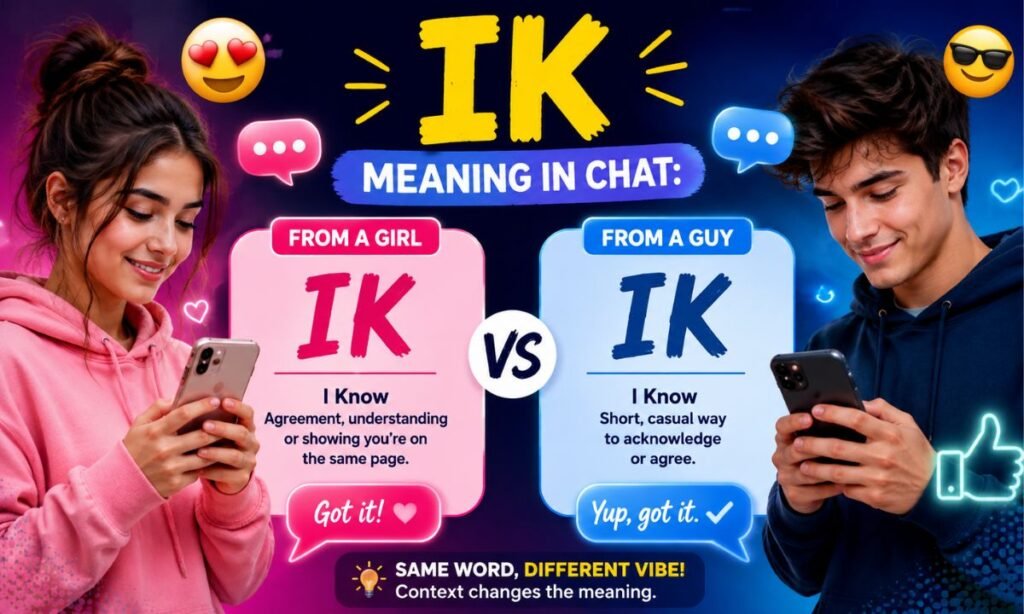
The meaning of “ik” doesn’t change based on who sends it. “I know” means the same thing regardless of gender.
What actually shapes the tone is the relationship between the people texting, the conversation’s history, and how much punctuation or emojis are used — not whether the sender is a girl or a guy.
Many people search this phrase because they’re trying to read into a specific message, often in a dating or flirting context. In that case, focus on the pattern of the conversation as a whole.
A warm, engaged conversation with an “ik 😊” usually signals interest and agreement. A short, flat “ik” in an otherwise quiet chat may simply mean the person is busy or not very engaged right now — regardless of gender.
Is IK Formal? (Professional Use)
No, IK is informal. It belongs in casual texting, not professional communication.
Use it comfortably with:
- Friends
- Family
- Casual group chats
- Social media comments
Avoid it in:
- Work emails
- Job applications
- Academic writing
- Formal reports
In professional settings, spell it out fully as “I know,” “I understand,” or “I’m aware of that.” These alternatives sound polished and won’t come across as dismissive, which “ik” sometimes can in serious conversations.
If you’re texting a coworker informally on a messaging app like Slack, a lowercase “ik” is usually fine. But in an email thread with your manager or client, it’s best to skip the abbreviation entirely.
Other IK Meanings (Physics, Medical & More)
Outside of texting, “IK” has a few unrelated technical meanings depending on the field.
- Physics/Robotics: IK can refer to inverse kinematics, a method used to calculate joint movement in robotics and animation.
- Medical: IK sometimes stands for interleukin, a type of protein involved in immune system signaling.
- Engineering: In some technical documentation, IK codes classify resistance to mechanical impact.
These meanings are entirely separate from the texting slang. You’ll only encounter them in specialized contexts like scientific papers, engineering specs, or medical literature — never in everyday chat.
If you see “IK” in a casual message, it almost certainly means “I know.” The technical meanings only apply within their specific fields.
Common Misconceptions
A common misconception is that “ik” always signals agreement. It usually does, but not always.
It can also express:
- Sarcasm
- Mild irritation
- Boredom or indifference
Another mix-up is confusing IK with IDK. They’re actually opposites — IK means you know something, while IDK means you don’t. Mixing them up in a fast conversation is an easy mistake to make.
Some people also assume “ik” is rude by default. It isn’t. Most of the time, it’s simply efficient — a quick way to confirm something without dragging out the reply.
Similar Terms & Abbreviations
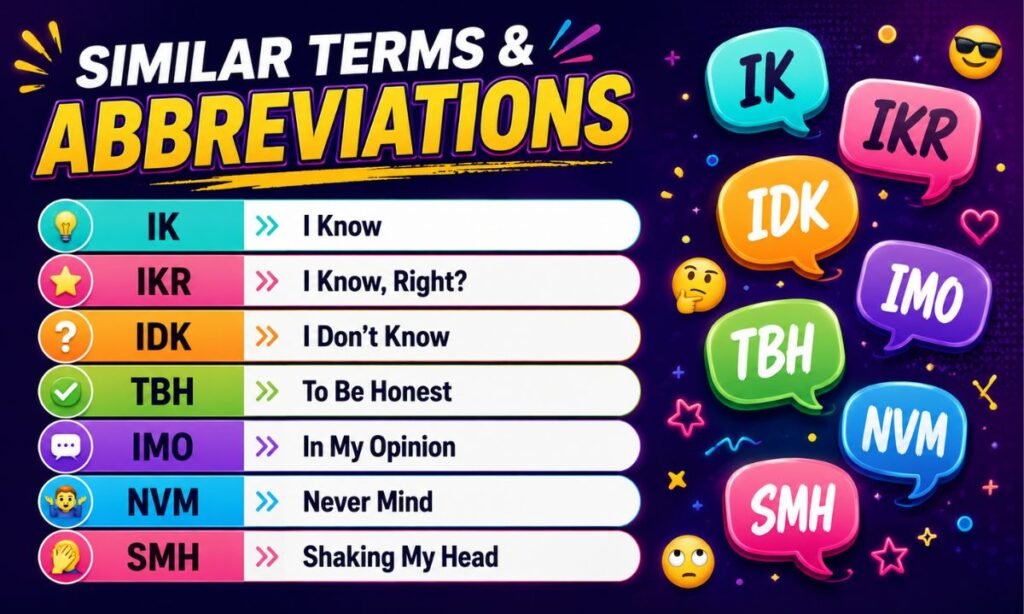
Several other texting abbreviations work similarly to “ik,” either as replacements or related expressions.
| Abbreviation | Meaning |
| IK | I Know |
| IKR | I Know, Right? |
| IDK | I Don’t Know |
| TBH | To Be Honest |
| IMO | In My Opinion |
| NVM | Never Mind |
| SMH | Shaking My Head |
Plain-English alternatives to “ik” include “yeah,” “got it,” “exactly,” and “true.” These work well when you want to sound slightly less clipped than a bare “ik.”
IK vs IDK vs IKR
These three abbreviations get mixed up often, but each means something different.
| Abbreviation | Full Form | Meaning |
| IK | I Know | You already know the information |
| IDK | I Don’t Know | You don’t have the answer |
| IKR | I Know, Right? | You agree strongly, often with a hint of relief or shared feeling |
Example:
- “The exam got moved up.” → “ik” (you already knew)
- “The exam got moved up.” → “idk, no one told me” (you didn’t know)
- “The exam got moved up.” → “ikr, so unfair” (strong agreement)
IKR adds emotional emphasis that plain “ik” doesn’t. It works best when you’re not just agreeing, but reacting to something surprising or frustrating.
What Does “ik ik” Mean?
“ik ik” is simply “ik” repeated twice for emphasis. It means “I know, I know.”
People double it up when they want to reassure someone quickly, especially if the other person is repeating a point or nagging a little.
For example:
- “Seriously, don’t forget this time.” → “ik ik, I promise.”
The repetition softens the reply. A single “ik” can sound short or dismissive, but “ik ik” often reads as playful or reassuring — like you’re acknowledging the reminder without brushing it off.
You’ll see this pattern with other abbreviations too, but it’s especially common with “ik” because it’s short enough to repeat without feeling excessive.
How to Reply to IK
How you respond to “ik” depends on the tone it seems to carry.
If it feels like agreement, keep the conversation going:
- “Right? It’s so good.”
- “Same here.”
- “Exactly.”
If it feels dismissive or short, a gentle follow-up works well:
- “Just making sure we’re on the same page.”
- “Okay, just checking.”
If it feels sarcastic, humor usually diffuses it:
- “Okay okay, I’ll stop reminding you.”
Most of the time, “ik” doesn’t need a big response — it’s a small acknowledgment, and a short reply back keeps the conversation natural instead of over-explaining a two-letter text.
Relevance in Online Conversations & Dating Apps
On dating apps and in online chats, “ik” often signals familiarity or shared understanding. Used warmly, it can suggest connection and ease in the conversation.
However, tone matters more here than almost anywhere else. Because first impressions form quickly on dating apps, a flat “ik” with no follow-up can come across as disinterested, even if that wasn’t the intention.
Pairing it with a follow-up thought — “ik, that’s what I was thinking too” — keeps the conversation moving and avoids sounding cold. On these platforms, it’s worth taking the extra second to add context rather than leaving a bare “ik” to be interpreted.
Tips for Using IK Correctly
A few quick guidelines help you use “ik” without sending the wrong message:
- Save it for casual conversations — friends, family, social media.
- Avoid it completely in professional or academic writing.
- Add an emoji or a short follow-up if you want to soften the tone.
- Consider whether the other person is familiar with texting abbreviations before using it.
- If a message feels important, spell out “I know” instead of shortening it.
Following these habits helps “ik” do what it’s meant to do: keep casual conversations quick and clear, without accidentally sounding dismissive.
Frequently Asked Questions
What does IK meaning in texting?
IK means “I know.” It’s used to show you already understand or agree with something being said.
Is IK the same as IKR?
No. IK means “I know,” while IKR means “I know, right?” — IKR adds stronger agreement or emotional emphasis.
Is IK rude?
Not usually. It can sound dismissive depending on tone and punctuation, but most of the time it’s just a quick, casual acknowledgment.
What does “ik ik” mean?
“ik ik” means “I know, I know,” repeated for emphasis. It’s often used to reassure someone in a lighthearted way.
Can I use IK in professional emails?
It’s best to avoid it. Write “I know” or “I understand” in full for formal or professional communication.
Conclusion
IK meaning comes down to two simple words: “I know.” It’s a quick, casual way to show agreement or acknowledge something without typing it all out.
Its tone shifts with punctuation, emojis, and context — sometimes warm, sometimes dismissive. Once you know the difference, reading and replying to “ik” becomes second nature.
From chat to dating apps, IK keeps conversations moving fast. Use it casually, skip it professionally, and you’ll never misread it again.